
My Gear
Disclaimer: I participate in a few affiliate programs, including but not limited to Amazon Associates, Birdfy, and Cotton Carrier. If you click on an affiliate link and make a purchase, I may receive a small commission at no extra cost to you. I see this as a win-win: hopefully, you discover products you love through me, and I receive a small percentage from your purchase which helps fund my content creation. However, I encourage you to do your own research before making any purchase.
I want to link my affiliate programs because they offer me better commission than Amazon does. If you want to support me more, I encourage you use there here! If you want to use Amazon, scroll down to the links below.
Birdfy Smart Bird Feeders: Use coupon code “hawkinthelens” for 15% off
Cotton Carrier: Use coupon code “hawkinthelens” for 10% off


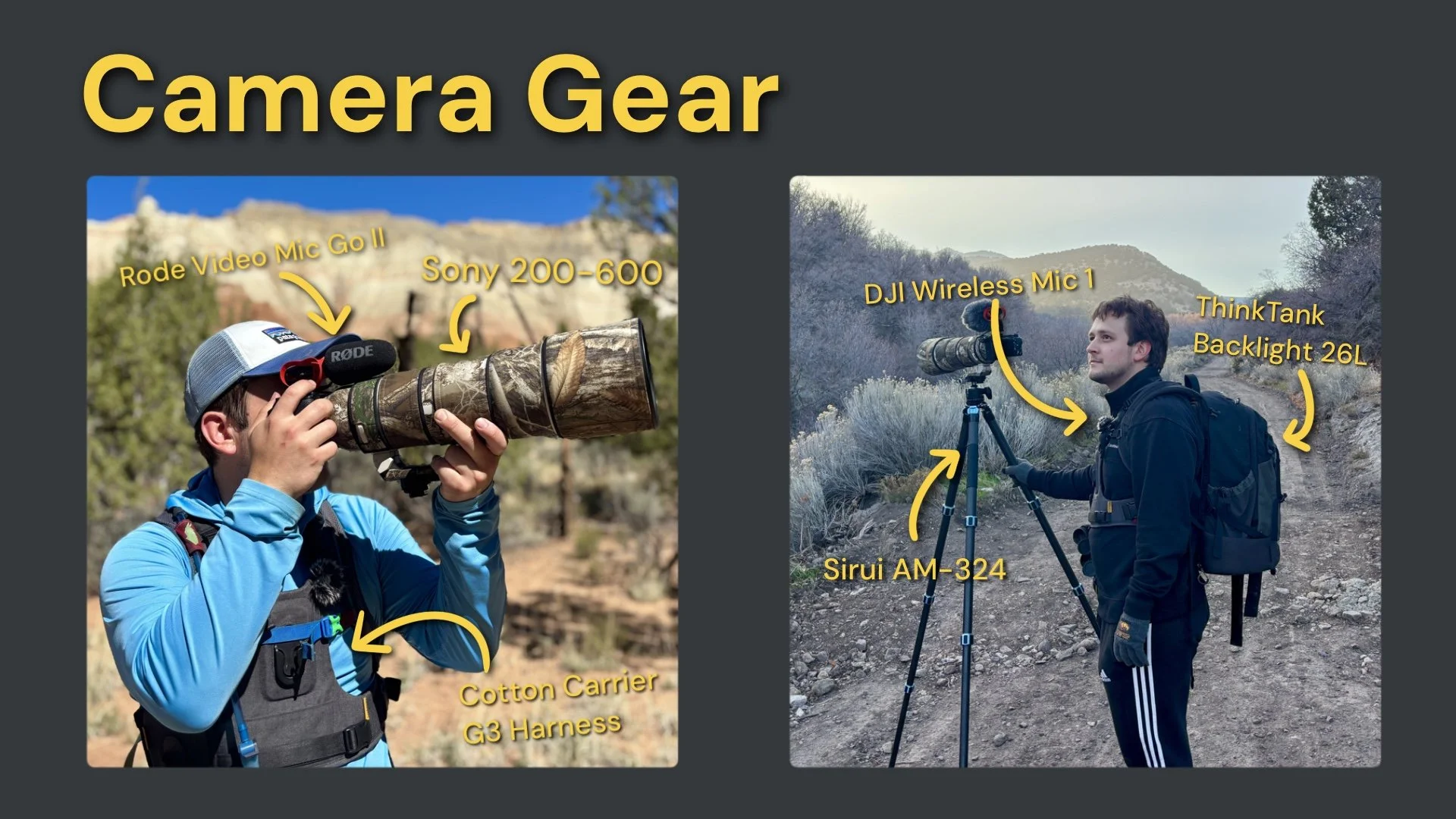
My camera kit has evolved over the past several years of making content. I started out with a used Sony A6400 and a Tamron 150-500mm lens before slowly upgrading over time. I bring that up to illustrate that you don't need the best gear to get going. Regardless, I will list all of my camera gear here for those who are interested.
99% of my wildlife footage is filmed with my Sony A7V and the Sony 200-600mm lens. The audio is captured with an on camera shotgun microphone (Rode Video Mic Go II). It works extremely well for me though I will say the setup is a bit heavy. That is why I use the Cotton Carrier G3 Harness to hold my setup on my chest as I move around in the field. When I use a tripod, it is the Sirui AM-324. This tripod has been the best balance I have been able to find on weight vs. stability of a large camera setup. I do find this balance to be highly personal so be aware this may not be your favorite. The ballhead on top is a separate 42mm ballhead from Cavix.
When I vlog, I literally just use my iPhone. It's the easiest method and I didn't have to carry a separate piece of gear to do so. The one part I did invest in however is the audio quality. Poor audio can really kill a video, and in the field you have to deal with many random noises. Wind is my least favorite thing when trying to record; which is exactly why I use the DJI Wireless Microphone (1st generation) and absolutely love it. I will likely upgrade to one of their latest versions someday (there's a 3rd gen out now), but I am really pleased with how this mic has held up.
There's a lot more that goes into the setup, but I find those pieces less interesting to touch on, so I will just give you the full list down below. As always, I highly recommend doing your own research on products that work for you. Even better, you can often rent gear to try it out for a bit before committing. Regardless, I hope this helps!
Camera Gear List
Main Camera: Sony A7V Mirrorless Camera - Amazon ● B&H Photo
On Camera Mic: Rode Video Mic Go II - Amazon ● B&H Photo (with windshield)
Camera Harness: Cotton Carrier G3 Camera Harness - Cotton Carrier (with discount) ● Amazon
Tripod: Sirui AM-324 - Amazon
Tripod Ball Head: Cavix Tripod Ball Head (46mm) - Amazon
Vlog Mic: DJI Wireless Mic Amazon ● B&H Photo (upgraded version of mine)
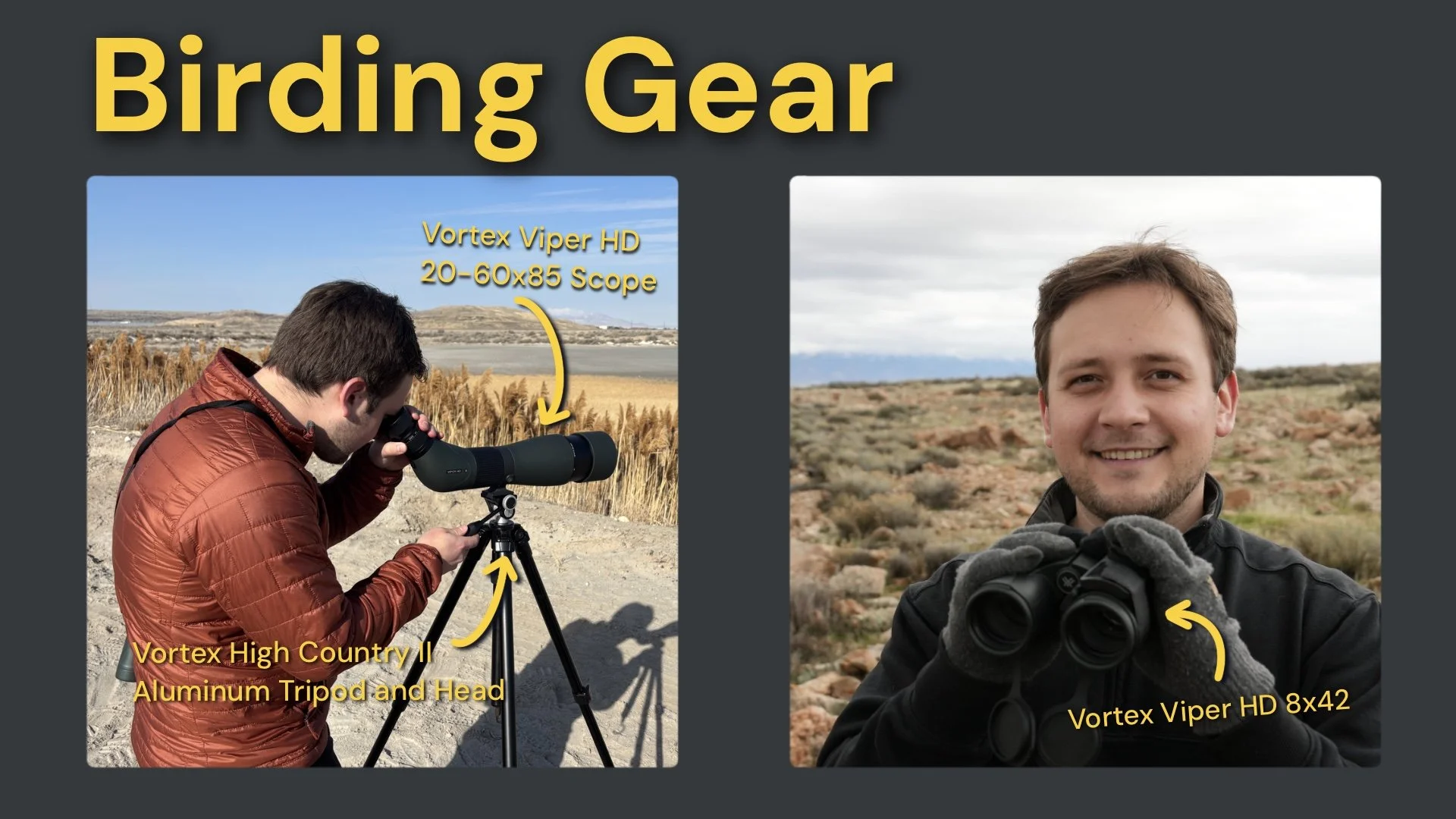
To be clear, you do not need much gear to get started with birding. The only thing I would recommend to start is a decent pair of binoculars. I began my birding journey with the Celestron Nature DX 8×42 binoculars. They worked great for two years! I eventually upgraded to the Vortex Viper HD 8×42mm binoculars which I have been extremely happy with. They are slightly brighter, and have a touch better quality than my Celestrons did. When you are buying a pair of binoculars, look for ones that are either 8×42mm or 10×42/ 10x50. I personally use 8×42, but you can do well with 10x zoom too.
If you are someone who loves looking at shorebirds or want to dip your toe into identifying gulls, then you also may want to look at investing in a scope. My first (and current) scope I chose was another product from Vortex, their midrange Viper HD 20-60×85mm Angled Scope. This has been a great piece of gear and a handful of my friends claim it is the best scope they have used. I don’t have much to compare it against myself, so I can’t say it’s the best ever, but I have also been happy with it. I will say, as you get towards the 60x magnification range the quality definitely drops off, but that is likely how most scopes are.
I also will list a handful of field guides that I have as options for starting to learn and get interested in birds. I want to be clear on one thing however, I do not use fields guides. Well, I should specify. I do not use physical field guides. After loving my Sibley Guide, I purchased the Sibley app for my iPhone and have absolutely loved it. It’s way easier to have an app on your phone in the field opposed to lugging around a book to look up birds. I also use and recommend the Merlin app by the Cornell Lab because it’s completely free, and another great resource. Still, physical field guides can be fun to flip through and I do like them as decor pieces for my studio.
Birding Gear List
Scope: Vortex Viper HD 20-60×85mm Angled - Amazon ● Vortex
This scope is expensive, I won’t lie to you. But I thought of it as a “buy it for life” purchase especially with Vortex’s lifetime warranty.
Field Guide Options
My Favorites: Sibley Field Guides - Full Edition on Amazon ● Birds of the West on Amazon ● Birds of the East on Amazon
Alternative Option: National Geographic Field Guide to the Birds of the United States and Canada, 8th Edition - Amazon
Gull Identification: The Gull Guide - Amazon - This guide is amazing for those who want to get better at telling apart gulls.